
M&M Compliance Training Services
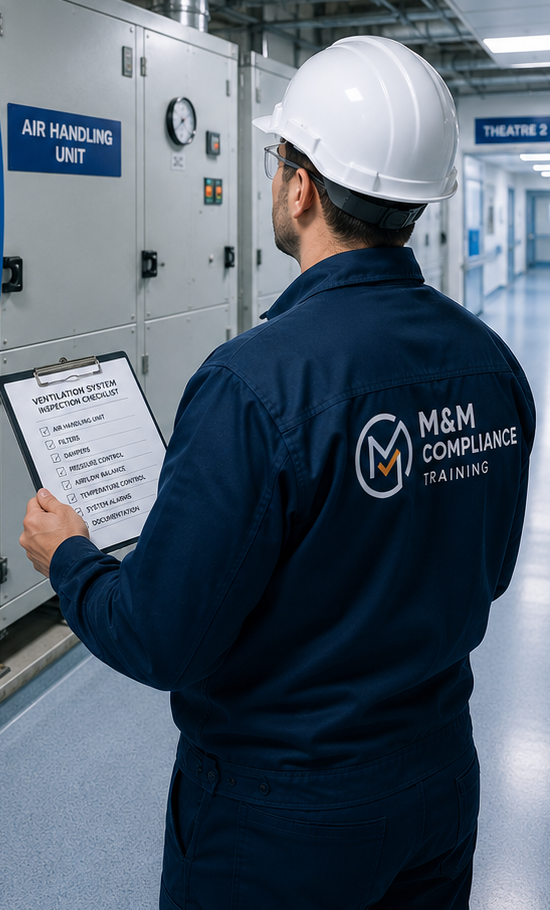
In an operating theatre, ventilation is not a comfort system — it is a clinical safety control. The air changes, pressure regimes and filtration that protect a patient on the table only work if the right competent people are appointed to design, operate and verify them. HTM 03-01 sets out exactly who those people are and what they must know. Here is how the roles fit together, and how to prove your team meets the standard.
Healthcare ventilation does work that no other building service does. It dilutes and removes airborne contaminants, maintains pressure differentials that keep clean and dirty areas apart, and delivers the ultra-clean air an operating theatre relies on to reduce the risk of surgical site infection. When a critical ventilation system underperforms, the consequence is not discomfort — it is a patient-safety and infection-control failure that can close a theatre.
That is why specialised ventilation in acute healthcare is governed so tightly, and why the people responsible for it sit at the centre of the safety case. The guidance is clear that managing these systems safely depends on a defined chain of competent, appointed roles — not on goodwill or whoever happens to be available.
Health Technical Memorandum 03-01: Specialised ventilation for healthcare premises is the recognised guidance for ventilation in healthcare buildings providing acute care. The current edition was published by what is now NHS England in 2021, superseding the 2007 version (and the older HTM 2025 and DV4 documents before it). It comes in two parts:
For other healthcare settings outside acute care, HTM 03-01 expects those responsible to risk-assess the nature of the treatment, the condition of patients and the intensity of use to decide how far the guidance applies. In other words, the standard is not optional in acute environments, and it is rarely irrelevant elsewhere.
HTM 03-01 is specialised ventilation. It is a different document from HTM 04-01 (safe water), HTM 02-01 (medical gas pipeline systems) and HTM 06-02 9low voltage electrical). Mixing up the references is one of the most common errors in estates documentation - and it undermines confidence in everything else in the file.
HTM 03-01 Part B describes a clear management structure, with each post carrying distinct responsibilities and competence expectations. The single most common compliance weakness is not a missing system - it is an unfilled or blurred role.
Duty Holder / Chief Executive
The organisation carrying ultimate legal accountability for safe ventilation under health and safety law. The duty cannot be contracted away.
Designated Person (Ventilation)
The board-level individual providing the informed link between the organisation and its ventilation safety arrangments, ensuring policies and resources are in place.
Authorising Engineer (Ventilation)
An independent professional who advises the organisation, assesses and recommends Authorised Persons, and audits the management system – deliberately separate from day-to-day delivery.
Authorised Person (Ventilation)
The operationally competent post that takes day-to-day control of the ventilation systems, issues permits, oversees contractors and manages the verification programme.
Competent Person (Ventilation)
The technically skilled person who carries out maintenance, testing and the measurements that underpin verification.
Ventilation Safety Group (VSG)
The multidisciplinary group — estates, infection prevention, clinical users — that governs ventilation safety and reports to the board through the Designated Person.
The structure is deliberately built on separation of duties. The Authorising Engineer advises and audits; the Authorised Person controls; the Competent Person tests; the VSG governs. When one party effectively occupies several of those roles at once, you lose the independent challenge that the system is designed to provide — and an auditor will notice.
A ventilation system is only ever as safe as the competence of the Authorised Person controlling it and the independence of the engineer auditing it.
HTM 03-01 is guidance, not a statute — but it sits on top of real legal duties that apply across Great Britain. The Health and Safety at Work etc. Act 1974 places general duties on employers to protect staff and others. The Workplace (Health, Safety and Welfare) Regulations 1992 require effective and suitable ventilation of enclosed workplaces. Where hazardous substances are involved, the Control of Substances Hazardous to Health Regulations 2002 (COSHH) also bite. Enforcement sits with the Health and Safety Executive (HSE), while the Care Quality Commission takes a close interest where ventilation failures affect patient safety.
HTM 03-01 is how acute healthcare turns those broad duties into specific, building-level expectations. Following it is the most straightforward way to demonstrate you have managed the risk to a recognised standard.
The Authorised Person (Ventilation) role demands demonstrable knowledge of HTM 03-01, the relevant standards, and the specific systems on site. Recognised AP(V), CP(V) and AE(V) training routes — delivered by bodies such as IHEEM and established healthcare training providers — build that knowledge and are widely treated by auditors as evidence of competence.
Explore our Authorised Person Ventilation Training Course, Competent Person Ventilation Training Course and Introduction to Healthcare Ventilation Course for role-appropriate training aligned with HTM 03-01 and SHTM 03-01.
But here is the distinction the standard cares about: certification is not the same as competence. A certificate records attendance on a date; competence is the knowledge, skill, training and experience applied to your theatres, isolation rooms and air-handling plant. A newly appointed AP(V) who understands the guidance in the abstract but has never been walked through the actual systems, validation history and quirks of the site is not yet fully competent for it. Genuine competence pairs recognised training with documented, site-specific familiarisation — and a competence record that proves both.
The 2021 edition changed expectations meaningfully from the 2007 version it replaced, and NHS England has continued to issue related air-cleaning guidance (for example on HEPA and UVC devices). Training, policies and your verification regime should track the current standard - not the version someone trained on a decadee ago.
HTM 03-01 Part B sets a clear performance-verification cadence: routine inspections through the year, with a more detailed annual performance verification of critical systems such as operating-theatre ventilation. Those checks only mean something if competent people plan them, coordinate the necessary shutdowns through a formal permit process, take accurate measurements and act on the results. The paperwork does not keep a theatre safe; the trained people behind it do.
(For the specific performance figures and the evidence and auditor expects to see, see our companion guide to HTM 03-01 annual verification )
The underpinning law — the HSWA, the Workplace Regulations and COSHH — applies across Great Britain. The healthcare guidance, however, is nation-specific. Acute services in England follow HTM 03-01; NHS Scotland uses the equivalent SHTM 03-01 issued through NHS Scotland Assure / Health Facilities Scotland. Estates teams operating across borders, or comparing course content between providers, should make sure training and documentation reference the correct national memorandum.
If you are the Designated Person or chair the Ventilation Safety Group, a practical, audit-ready approach looks like this:
We work with NHS trusts, healthcare estates teams and facilities providers across the UK to turn HTM 03-01 and its underpinning law into a single, defensible competence framework. That means role-based ventilation training mapped to the Authorised Person (Ventilation), Competent Person and Designated Person duties, support to structure your Ventilation Safety Group, and the documentation you need to satisfy auditors, the HSE and your own governance. The result is not a certificate on a wall — it is people who are genuinely competent on your ventilation systems, and the evidence trail to prove it.
Talk to our team about HTM 03-01 ventilation training and competence assessment tailored to your estate, your roles and your verification duties.
Speak to a compliance specialistNHS England – https://www.england.nhs.uk/publication/specialised-ventilation-for-healthcare-buildings/
NHS England – https://www.england.nhs.uk/wp-content/uploads/2021/05/HTM0301-PartB-accessible-F6.pdf
HSE – https://www.hse.gov.uk/ventilation/
HSE – https://www.legislation.gov.uk/uksi/1992/3004/contents/made
HSE – https://www.hse.gov.uk/coshh/
IHEEM – https://www.iheem.org.uk/learning-hub/training-courses/authorised-person-ventilation-htm-03-01/
Regulatory position checked against NHS England and HSE primary sources on 13 July 2026. The HSWA 1974, the Workplace (Health, Safety and Welfare) Regulations 1992 and COSHH 2002 apply across Great Britain; healthcare ventilation guidance is nation-specific (HTM 03-01 in England, SHTM 03-01 in Scotland). Northern Ireland has separate but broadly equivalent provisions.
We’re here to support you. Just fill out the form and one of our team members will be in touch shortly to discuss your requirements.