
M&M Compliance Training
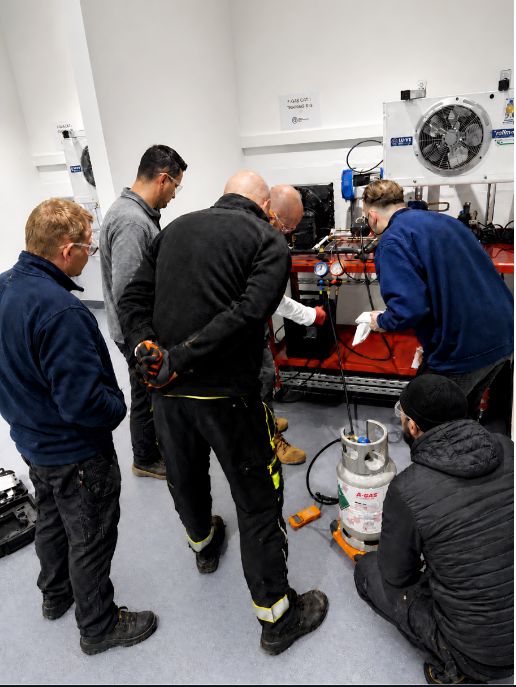
If you work in refrigeration, air conditioning, or heat pump installationand maintenance, 2026 is a good year to take stock of your F-Gascompliance position. The GB service ban on the highest-GWPrefrigerants has been in force for several years, a new HFC phasedownis on the horizon — though not yet legislated — and the shift tolower-GWP and natural refrigerants is accelerating the demand forupdated skills.
This guide cuts through the noise. It explains what the GB rulesactually say, what is genuinely changing versus what is still inconsultation, what F-Gas certification you need and how to get it,and how M&M Compliance Training can support you and yourorganisation.
M&M Compliance Training offers accredited F-Gas training, refresherand reassessment options across the UK. Get in touch for a coursedate or tailored quote.
Fluorinated greenhouse gases — commonly called F-Gases — are agroup of man-made chemicals used in refrigeration systems, airconditioning units, heat pumps, and certain electrical switchgear. Themost prevalent are hydrofluorocarbons (HFCs), which includecommon refrigerants such as R-410A, R-404A, and R-134a.
They are regulated because of their environmental impact. HFCshave a global warming potential (GWP) many hundreds or thousandsof times greater than CO₂ — R-404A, for example, has a GWP ofaround 3,922. Since leaving the EU, Great Britain has maintained itsown F-Gas regulatory framework under the retained FluorinatedGreenhouse Gas Regulation, and the rules on who can handle thesegases, and under what conditions, are enforced by the EnvironmentAgency.
The following table summarises the GB compliance position for keyrefrigerants:
Refrigerant
GWP
Common Use
GB Status (2026)
R-404A
3,922
Commercial refrigeration
Virgin use banned in existing systems ≥40 tCO₂e since 2020. Reclaimed/recycled exempt.
R-507A
3,985
Commercial refrigeration
Same as R-404A — GWP >2,500 service ban applies to systems ≥40 tCO₂e.
R-410A
2,088
HVAC, heat pumps
Permitted for servicing existing equipment. Note: new single split systems <3 kg with GWP >750 banned from GB market from 2025.
R-134a
1,430
AC, industrial, automative
Permitted. Including in long-term phase-down trajectory.
R-23
675
HVAC, heat pumps
Permitted. Increasingly specified as lower-GWP alternative.
R-290 (propane)
3
Small commercial, domestic
Natural refrigeration. Requires appropriate competence and training due to A3 flammability risk.
Since Brexit, GB operates its own F-Gas regulatory framework, whichhas diverged from EU Regulation 2024/573. Some figures quotedelsewhere — including a €3/tCO₂e quota charge and a 2032 end-datefor reclaimed refrigerant use — relate specifically to the EU, not GB.Always check GOV.UK guidance for the GB position.
The most important compliance point for engineers working with R-404A, R-507A, and other refrigerants with a GWP above 2,500 is the GB service ban — and it is not a new 2026 development. This ban has been in force since 2020. Under GB F-Gas rules, virgin (newly manufactured) F-Gas with a GWP above 2,500 cannot be used to service or maintain refrigeration systems where both of the following conditions apply:
To put that in practical terms: R-404A has a GWP of 3,922, so 40 tCO₂e corresponds to approximately 10.2 kg of charge. Any commercial refrigeration system with an R-404A or R-507A charge above roughly 10 kg is covered by this ban — and for those systems, engineers must use reclaimed or recycled refrigerant rather than virgin product.
Reclaimed and recycled high-GWP refrigerant (GWP >2,500) maycontinue to be used in existing GB refrigeration equipment.According to REFCOM guidance, this exemption applies until 1January 2030 for GB. (The 2032 date cited in some sources refersto EU Regulation 2024/573, which does not apply in Great Britain.)Always verify the current position before advising clients onrefrigerant strategy.
- Source: REFCOM F-Gas Service Ban guidance
2026 is significant not because a new ban has come into force, but because the direction of travel for GB F-Gas regulation is becoming clearer — and more demanding.
In November 2025, Defra launched a consultation on amending the GB HFC phasedown schedule, seeking views on proposals to reduce the amount of HFCs placed on the GB market beyond current legislative limits. The consultation closed on 17 December 2025 and attracted 137 responses.
In May 2026, Defra published an update confirming two things:
Defra has confirmed it remains committed to ambitious reform, and will publish a response summarising consultation feedback and next steps later in 2026. The direction of travel remains towards tighter control of HFCs, but the specific GB timeline has not yet been legislated.
2026 is the year to review your refrigerant strategyand training position — not because a new ban hasarrived, but because the trajectory is set and the shiftto lower-GWP refrigerants is already well underway.
If you carry out regulated work on equipment containing fluorinatedrefrigerants — including installation, servicing, maintenance, leakchecking or refrigerant recovery — you must hold the appropriate FGasqualification. This applies to individuals and to companies,and the requirements are separate.
Where the work falls within regulated activities, it is against the law to work with F-Gas without the correct qualifications. The relevant environmental regulator — the Environment Agency in England, or SEPA in Scotland — can issue civil penalties for non-compliance. If you see someone working with F-Gas without the right qualifications, you can report it to [email protected].
Individual Qualifications
Individual engineers must hold a qualification from one of the Government-approved awarding organisations. For stationary refrigeration, air conditioning, and heat pump (RACHP) systems,
these are currently:
The four qualification categories and their scope are set out in the table below. The qualification you need depends on the activities you carry out and the charge size of the equipment you work on.
Category
Scope (RACHP systems)
Typical Training Duration
Category 1
All activities: installation, maintenance, servicing, refrigerant recovery, and leak checking on stationary refrigeration, air conditioning and heat pump equipment – across all charge sizes
4-5 days
Category 2
Install, maintain, service, and recover refrigerant from systems with a charge of
less than 3 kg (less than 6 kg if hermetically sealed)
2-3 days
Category 3
Recover refrigerant from systems with a charge of less than 3 kg (less than 6 kg if
hermetically sealed)
1-2 days
Category 4
Leak checking only, without breaking into the refrigeration circuit
1 day
GOV.UK does not specify a uniform expiry period for individual RACHPF-Gas qualifications. The validity of your certificate depends on theawarding body and the specific qualification route. If you hold a City& Guilds 2079 qualification, check directly with your awarding bodyor employer whether and when revalidation applies. Company F-Gascertification (see below) is a separate matter and is typically renewedon a fixed cycle.
Company Certification
In addition to individual qualifications, companies that carry out FGas work must hold a company F-Gas certificate through an approved company certification scheme. Having certified engineers but no company certificate does not satisfy the legal requirement.
Common company certification schemes in GB include REFCOM, Quidos, and Bureau Veritas — these are distinct from the awarding organisations that issue individual qualifications.
Company certification is typically renewed on a regular cycle (often
every three years, depending on the scheme). Check with your
certification body for renewal requirements.
One of the most significant practical shifts for HVAC engineers over the past few years has been the growing prevalence of mildly flammable (A2L) refrigerants such as R-32, R-454B, and R-1234yf.These lower-GWP alternatives are increasingly specified in new equipment — particularly heat pumps and split-system air conditioning — but they require a different approach to safe handling compared to the A1 (non-flammable) refrigerants that dominated the market for decades.
Working safely with A2L refrigerants involves understanding theirspecific ignition risks, appropriate ventilation requirements forservice environments, and the use of compatible tools and leakdetection equipment. Engineers whose qualification pre-dates theA2L era should consider whether their CPD record reflects this area— and if not, it is worth discussing refresher options with a trainingprovider.
NHS & HEALTHCARE ESTATES NOTE
Many healthcare facilities managers hold F-Gas obligations alongsidebroader HTM compliance responsibilities. M&M's training portfoliocovers both — from F-Gas certification through to Authorised Personand Authorising Engineer appointments under healthcare technicalmemoranda
M&M Compliance Training Services (MMCTS) delivers accredited FGas training for engineers and organisations across the UK. Our courses are delivered through City & Guilds-approved routes,providing independently verified competence that employers and clients can rely on.
What sets M&M apart is our grounding in the broader compliance landscape. Many of our learners are NHS and healthcare estates professionals who hold F-Gas responsibilities alongside HTM duties —and our trainers understand both worlds. Course content is reviewed to keep pace with regulatory and technical developments, including the emerging A2L skills agenda.
We offer flexible delivery options and are happy to work around operational requirements. Whether you need to certify a single engineer or train a team across a facilities management operation,we can help — get in touch to discuss dates and requirements.
Not sure whether your team's certification covers everything it should — or whether your qualifications reflect the latest refrigerant landscape? Get in touch and we'll help you identify the right course and book a date that works.
Speak to M&M TodayYes, where the work falls within regulated activities. If you carry outregulated work on equipment containing fluorinated refrigerants —including installation, servicing, maintenance, leak checking orrefrigerant recovery — you must hold the appropriate F-Gasqualification. The employing company must also hold companycertification where required. Operating without the correctqualifications can result in civil penalties from the relevantenvironmental regulator.
Yes, but with important caveats. In Great Britain, there is a service ban on using virgin (newly manufactured) F-Gas with a GWP above 2,500— including R-404A and R-507A — where the refrigeration equipment contains 40 tonnes CO₂ equivalent or more. This ban has been in force since 2020. Reclaimed or recycled refrigerant of the same type may still be used in existing equipment (until 1 January 2030 in GB,according to REFCOM guidance). Existing systems are not automatically illegal — the ban applies to the use of virgin refrigerant to top them up, not to their continued operation.
No new legislation has come into force in 2026. Defra ran a consultation in late 2025 on tightening the GB HFC phase down schedule, but confirmed in May 2026 that it will not legislate in 2026to change the phase down steps from 1 January 2027. Further work is underway and next steps will be published later in 2026. The direction of travel is toward tighter restrictions — but the specific timeline is not yet legislated.
Category 1 training — the most comprehensive, covering all activities on systems with charges of 3 kg or more — typically takes four to five days. Categories 2, 3, and 4 are shorter, ranging from one to three days depending on the scope. M&M delivers both classroom-based and blended learning options to fit around operational schedules.
R-410A (GWP 2,088) can generally still be used to service existing HVAC equipment. However, from 2025 new single split systems containing less than 3 kg of F-Gas with a GWP above 750 were banned from being placed on the GB market - which affects many R-410A split systems when it comes to new on installations. If you are specifying new equipment, check the current product prohibitions guidance on GOV.UK.
Yes — both are required separately. Individual engineers must hold apersonal qualification from an approved awarding body. The companythey work for must also hold a company F-Gas certificate through anapproved scheme such as REFCOM, Quidos, or Bureau Veritas. Havingone without the other does not satisfy the legal requirement.
- GOV.UK - Qualifications required to work with F-Gas (updated 3 March 2026)
- GOV.UK — Amending the HFC phasedown schedule (updated 15 May 2026)
- GOV.UK — Banned F-Gas for refilling equipment
- GOV.UK — Bans on F-Gas in new products and equipment
- REFCOM — F-Gas servi
We’re here to support you. Just fill out the form and one of our team members will be in touch shortly to discuss your requirements.